( SSL / TLS ): Essential Tools for Securing Internet Data

To Understand SSL/TLS firstly we see where it used ,
HTTP vs HTTPS: Understanding Secure Communication
HTTP (Hypertext Transfer Protocol):
Standard protocol for transferring data between a web browser and a server.
Data is sent in plaintext, making it vulnerable to interception (e.g., man-in-the-middle attacks).
HTTPS (HTTP Secure):
Secure version of HTTP that uses encryption (SSL/TLS) to protect data.
Provides confidentiality, integrity, and authentication.
Recognizable by the padlock symbol in browsers and the "https://" prefix.
Inthe digital age, where sensitive data is exchanged online every second, ensuring the security and privacy of this data is paramount. This is where SSL (Secure Sockets Layer) and its successor, TLS (Transport Layer Security), come into play. These protocols have become the backbone of secure communication on the internet, protecting users and businesses alike from potential cyber threats.
# What Are SSL and TLS ?
SSL (Secure Sockets Layer):
Introduced in the mid-1990s, SSL was the first widely used encryption protocol for securing online communications.
It created an encrypted link between a user's browser and a web server, ensuring that any data transmitted was private.
However, SSL had vulnerabilities and was eventually replaced by TLS.
TLS (Transport Layer Security):
TLS is the more secure and efficient successor to SSL.
It addresses the security flaws in SSL and provides enhanced encryption algorithms.
TLS is now the standard for secure communication on the internet, and references to "SSL" often mean "TLS" in modern contexts.
How does SSL/TLS work ?
These are the essential principles to grasp for understanding how SSL/TLS works:
Secure communication begins with a TLS handshake, in which the two communicating parties open a secure connection and exchange the public key
During the TLS handshake, the two parties generate session keys, and the session keys encrypt and decrypt all communications after the TLS handshake
Different session keys are used to encrypt communications in each new session
TLS ensures that the party on the server side, or the website the user is interacting with, is actually who they claim to be
TLS also ensures that data has not been altered, since a message authentication code (MAC) is included with transmissions
With TLS, both HTTP data that users send to a website (by clicking, filling out forms, etc.) and the HTTP data that websites send to users is encrypted. Encrypted data has to be decrypted by the recipient using a key.
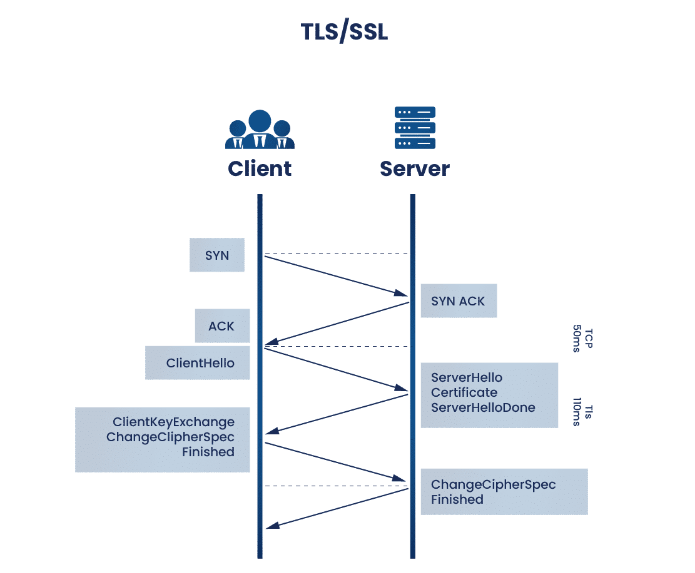
The TLS handshake :
![SSL/TLS Handshake Process [3]](https://www.researchgate.net/profile/Muhammad-Zunnurain-Hussain/publication/379144405/figure/fig1/AS:11431281230649069@1711035819949/SSL-TLS-Handshake-Process-3.png)
TLS communication sessions begin with a TLS handshake. A TLS handshake uses something called asymmetric encryption, meaning that two different keys are used on the two ends of the conversation. This is possible because of a technique called public key cryptography.
In public key cryptography, two keys are used: a public key, which the server makes available publicly, and a private key, which is kept secret and only used on the server side. Data encrypted with the public key can only be decrypted with the private key.
During the TLS handshake, the client and server use the public and private keys to exchange randomly generated data, and this random data is used to create new keys for encryption, called the session keys.
Symmetric encryption with session keys
Unlike asymmetric encryption, in symmetric encryption the two parties in a conversation use the same key. After the TLS handshake, both sides use the same session keys for encryption. Once session keys are in use, the public and private keys are not used anymore. Session keys are temporary keys that are not used again once the session is terminated. A new, random set of session keys will be created for the next session.

Applications of SSL/TLS
Web Browsing:
Used in HTTPS to secure communication between a browser and a web server.Email Communication:
Protects email transmissions through protocols like SMTP, IMAP, and POP3.File Transfers:
Secures file transfers using protocols like FTPS and SFTP.VPNs:
Ensures encrypted communication in Virtual Private Networks.APIs:
Protects data exchanged between applications and servers via secure APIs
The Evolution of SSL/TLS
![SSL/TLS Versions Development Timeline [5]](https://www.researchgate.net/profile/Muhammad-Zunnurain-Hussain/publication/379144405/figure/fig2/AS:11431281230666284@1711035820082/SSL-TLS-Versions-Development-Timeline-5.png)
Conclusion
SSL/TLS has become an integral part of online security, enabling secure communication and protecting sensitive data from cyber threats. As the internet continues to evolve, the importance of these protocols will only grow. For website owners, implementing SSL/TLS is no longer optional—it's a necessity for maintaining trust, security, and compliance in the digital world.